- +919625382039
- A 84 shastri nagar, 3, Ashok Vihar, Delhi, 110052
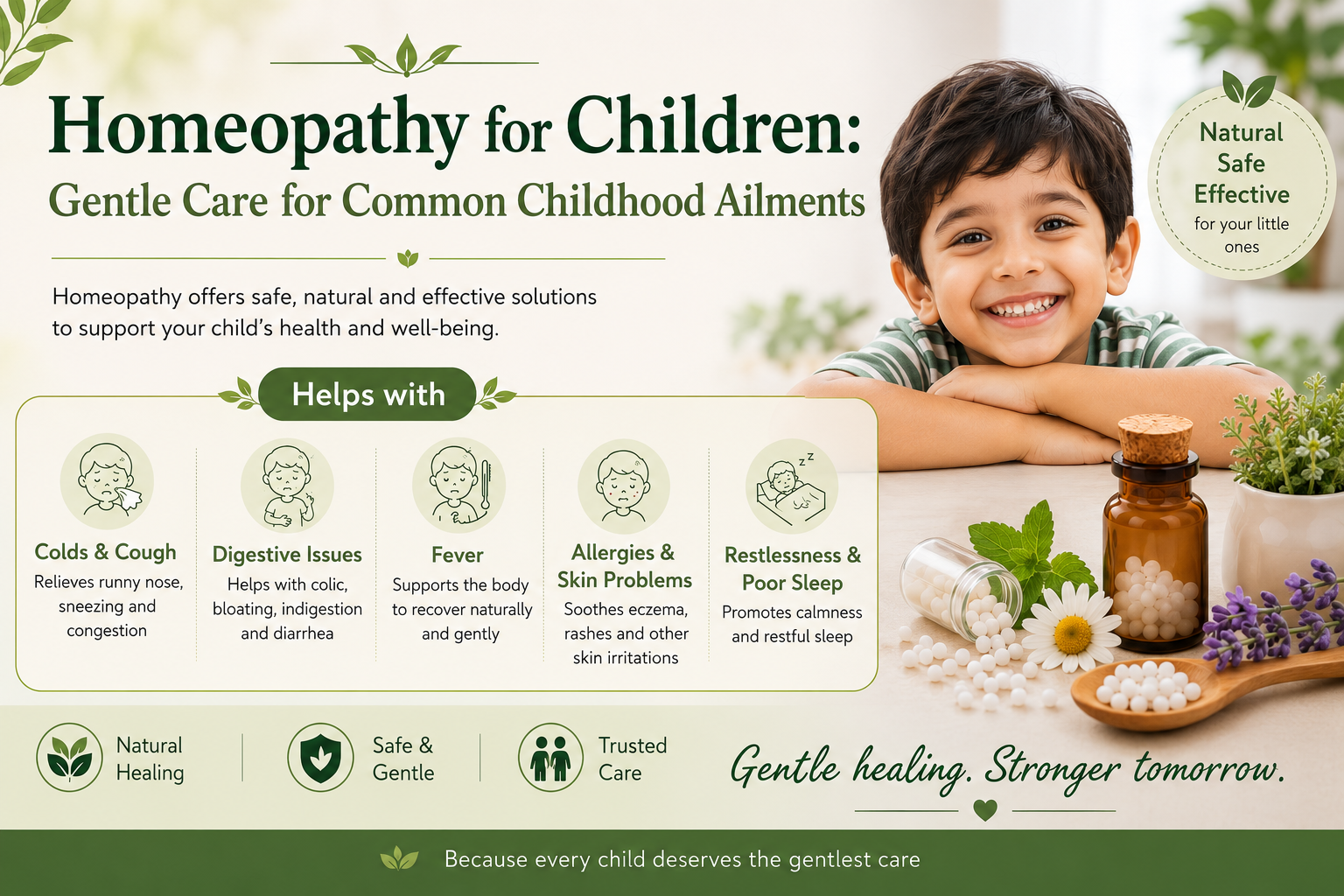
As a parent, few things are harder than watching your child feel unwell — whether it’s a stuffy nose, a restless night from teething, or an upset tummy. It’s no surprise that more parents are exploring gentle, natural approaches to complement the care their children receive, and homeopathy is one path many families choose to look into.
Children’s bodies are still developing, and many parents naturally feel cautious about frequent or strong interventions for minor, everyday complaints. This has led many families to seek out approaches that are seen as gentle and supportive of the body’s own healing tendencies — while still keeping their pediatrician closely involved in their child’s overall care.
Some of the everyday concerns parents commonly bring to a homeopathic consultation include:
Homeopathic care for children, like for adults, is individualized. A practitioner will typically ask detailed questions not just about the physical symptom, but about your child’s temperament, appetite, sleep patterns, and general behavior, since all of these factors are considered part of the full picture.
A first consultation for a child is usually a relaxed, conversational process. The practitioner will likely ask you (and, depending on age, your child) questions about:
Based on this complete picture, the practitioner may suggest an individualized approach for your child’s care.
Homeopathy is often used as a complementary approach rather than a substitute for standard pediatric care. It’s important to:
Myth: Homeopathy just means giving my child “natural” versions of medicine. Homeopathy is a distinct system of care with its own principles — it isn’t simply “herbal medicine” or a natural substitute for pharmaceuticals.
Myth: It’s a replacement for vaccinations or emergency care. Homeopathy is not a substitute for vaccinations, emergency medical treatment, or care for serious illness. It’s best understood as a complementary approach for everyday wellness concerns.
Myth: All children need the same remedy for the same symptom. Because homeopathy considers the whole child — not just the isolated symptom — two children with a cold might be looked at quite differently by a practitioner.
Many parents appreciate that a homeopathic consultation takes time to understand their child as a whole person, not just a list of symptoms. If you’re curious whether this approach might be a good fit for your family, the best first step is a conversation with a qualified practitioner.
For any online health consultation coonect Dr Pooja , schedule your appointment today…
All right reserved with © Dr. Pooja Jaiswal Homoeopathic clinic 2025